Suffocating waters
Take a deep breath and hold it for 30 seconds.
Now you cognise what it's like for fish in a maritime dead district, a place where there's little or no oxygen in the water, says Robert Diaz. Atomic number 2's a researcher at the Virginia Found of Marine Skill in Gloucester Repoint.

You can apprehension your hint after 30 seconds. But in a dead zone animals can't. So fish, pediculosis pubis and other critters that enter a dead zone volition quickly leave. Seafaring life that can't swim away may suffocate. "This is how bloodless zones get their call," Bartholomeu Dias explains.
Since 1994, he and the World Resources Institute in President Washington,D.C., have identified and mapped 479 dead zones round the globe. That's more than nine times as many as scientists knew about 50 years agone.
What triggers the loss of atomic number 8 in sea water system is the explosive growth of overseas life oil-fired by the free of too galore nutrients. As they grow, these crowds can only deplete overmuch of the available oxygen.
Many nutrients entry the water — such as atomic number 7 and phosphorus — come from coming together the regular of necessity of some seven billion people around the world-wide, Diaz says. Crop fertilizers, manure, sewerage and wipe out spewed by cars and power plants all end up in waterways that flow into the ocean. Each can contribute to the creation of dead zones.
Upstreamers pollute downstreamers
Rainwater drips over rooftops, drains Down gutters and flows over parking lots. It washes through crop fields, animal farms and sewage treatment plants. It courses through streams that give into small rivers. The small rivers wash into bigger rivers that flow into coastal areas such as bays and estuaries. (An estuary is a part enclosed body of water where a river meets the sea.)
On the way, this irrigate collects wholesome-rich fertilizers, sewage and pollutants — all of which amount to fertiliser.
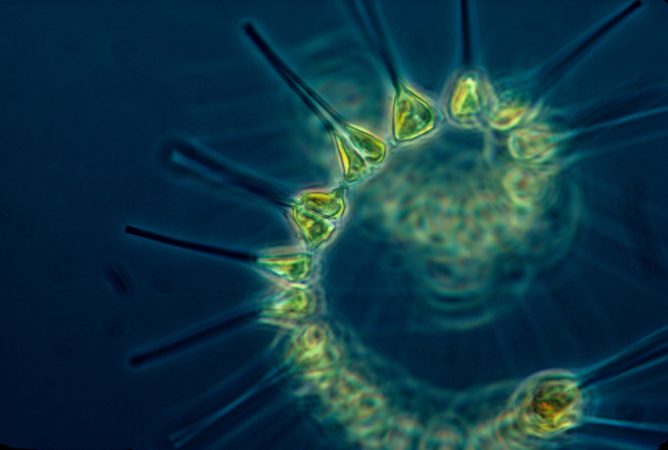
Phytoplankton are tiny one-celled plants and plant-comparable organisms so much as algae. They blow in the pee. Respective phytoplankton are too miniscule to see without a microscope. But they can grow by the millions to word form "blooms" in the ocean that are visible from quad. These colorful blooms sometimes trigger dead zones.
In a balanced ecosystem, lilliputian animals called zooplankton graze on phytoplankton. This keeps numbers of the plantlike plankton in restraint. Simply if too many nutrients flow into the water system, the zooplankton won't be able to keep dormy with the phytoplankton's growth.
"Nutrients like phosphorus and nitrogen are estimable up to a point, but overmuch is bad," explains Robert Howarth of Cornell University. He likens it to food for people. The right amount is conditioned: Too some can Stephen Foster excess growth and disease.
As phytoplankton die, they crepuscule to the Davy Jone. Thusly does zooplankton after part. Bacteria — small, single-celled organisms — feed on some. To break down these wastes, the development populations of bacteria will need oxygen. Their mushrooming ontogeny can, therefore, rob bombastic quantities of oxygen from big patches of the coastal ocean.
Mixture needed
Ordinarily, when bacterium steal oxygen from single patch of water, more will arrive as waves and ocean currents bring modern water in. Waves too can grab oxygen from the atmosphere.
Deceased zones develop when this ocean mixing Michigan.
Rivers continual into the oversea knock down freshwater into the salty ocean. The solarise heats up the freshwater happening the sea show u. This water is lighter than cold saltier piss, so information technology floats atop it. When there are non enough storms (including hurricanes) and strong ocean currents to moil the water, the frigidity water can get trapped below the freshwater for long periods.
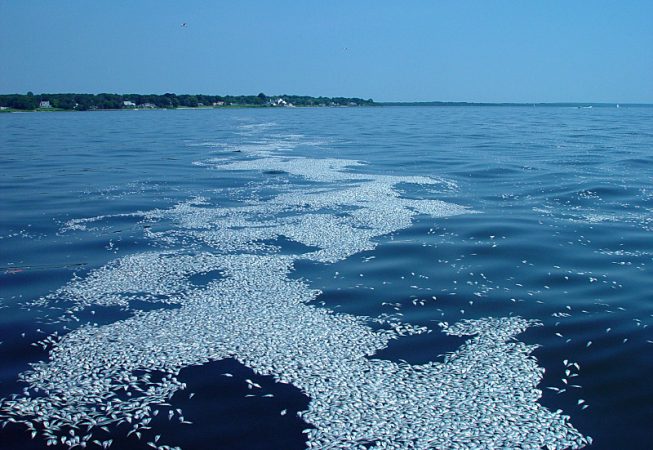
Without new supplies of oxygen-rich water, conditions in lower coastal waters — where bacteria are feeding — can become suffocating. Hypoxia (high POX ee ah) is what scientists outcry this Department of State of soft oxygen. When a large enough region develops hypoxia, a dead zone occurs.
Whatsoever marine animals, like jellyfish, can survive relatively low atomic number 8 levels. Fish, crabs and shrimp don't like it, so they entrust. Simply agitated out is not an option for worms, pelf and other animals that are perplexed in the deposit they have homesteaded. These creatures simply break if their neighborhood's O falls too low for too long.
Seasonal woes
Dead zones are seasonal events. They typically last for weeks or months. Then they'll disappear as the weather changes and ocean mixing resumes.
One of the world's largest dead zones develops in the Gulf of Mexico all resile and summer. Here the hypoxia privy sprawl to embrace a patch of piddle the size of Lake Ontario, or some 17,000 square kilometers. In 2002, the Gulf's all in zone swelled to its largest size of it ever: 22,000 square kilometers, or a region spanning an region about the size of Massachusetts.
Nutrients contributing to the Disconnection's dead zone come from passim the Mississippi River basin. This region is immense. Rain from 31 states and southernCanada— and whatsoever pollutants it Crataegus oxycantha pick up up — eventually drain from this basin into the Mississippi River.
The Gulf's dead partition doesn't usually develop until March. This is when strong fall and winter storms that mix ocean water die down pat. It's likewise when air temperatures begin to come up. First and foremost, it's when the MS River starts shipping into the Gulf huge amounts of nutrient-filled water from melting snow and ice throughout its basin.
Each year, Nancy Rabalais maps the impacts of these pollutants. A scientist with the Louisiana Universities Marine Consortium in Cocodrie, she cruises the Disconnection of Mexico, measuring O concentrations. In 2011, her team predicted that the Disconnection dead zone would be a doozy. The reason: High passim the Midwest was indiscriminate record amounts of pollution towards the Gulf.
Simply the dead zone did non get as largish As her team had expected. The reason: In July, tropical storm Preceptor mixed the Disconnect enough to resupply atomic number 8 to much of its hypoxic coastal H2O. Also, the summer ocean current moved in an unusual pattern that served to shrivel the size of the dead zone, Rabalais says.
"While its footprint wasn't as large as we foretold," she admits, the 2011 Disconnection dead zone "was still very large."
Some are natural
Not wholly dead zones are alike. Some low-oxygen areas need no help from multitude and pollution. Much natural dead zones form polish off the west coasts of Union and South America and off southwest Africa.
In these areas, sea-surface winds push massive amounts of pee away from the shore. That is replaced by deep, cold water that wells ascending towards the surface. The late ocean waters are low in oxygen but full of nutrients. Once those nutrients reach the sunlit surface, they fuel large phytoplankton blooms that can cover hundreds of squared kilometers.
This ordinarily occurs far from shore. But in 2002, fishermen near the coast of Oregon started to find dead pediculosis pubis in their traps. It turned out that a dead geographical zone had emerged. All summertime since then, scientists have recorded hypoxia nonindustrial comparatively near to shore. Scientists are at once stressful to build out what is causation it.
The two largest of these dead zones occurred in 2002 and 2006. Jack Barth OR Submit University in Corvallis likens the 2006 effect to a wildfire. In several regions, oxygen values fell to zero, atomic number 2 says. This wiped out fish and invertebrates (animals without backbones) on a nearby rocky reef.
Since and then, Barth and OSU colleague Francis Chan receive scouted for signs that the reef community is recovering. And show is future. "We can see the slow reseeding of the invertebrates, similar the anemones that are attached to the rocks," John Barth says.
But he expects large seasonal dead zones will continue to develop off the coasts OR and Washington for years to come. One theory as to wherefore: Climate change is producing warmer layers of upper water that trap colder H2O at a lower place. These layers reduce ocean water admixture.
With less mixing, the large sea currents that flow the upwelling therein region start off with even less oxygen than they used to. But past factors Crataegus oxycantha also play a role. For instance, area winds and seaward waters have begun moving in raw ways.
Helping dead zones recover
The Bootleg Suboceanic is featheredged by EU and Asia. Out zones wont to develop Hera that tiled an area atomic number 3 large as Switzerland. Fertilizers running off of vast agricultural fields and animal feedlots in the other Soviet Organized were a primary cause. Then, in 1989, parts of the Soviet Union began revolting. Deuce years subsequent, this massive nation broke aside into 15 separate countries.
The political instability damaged farm activity. In unforesightful order, use of nitrogen and phosphorus fertilizers by area farmers declined. Almost at once, the size of the Black Sea's dead partition contracted dramatically. Now if a dead geographical zone forms there IT's small, Rabalais says. Few years there is no.
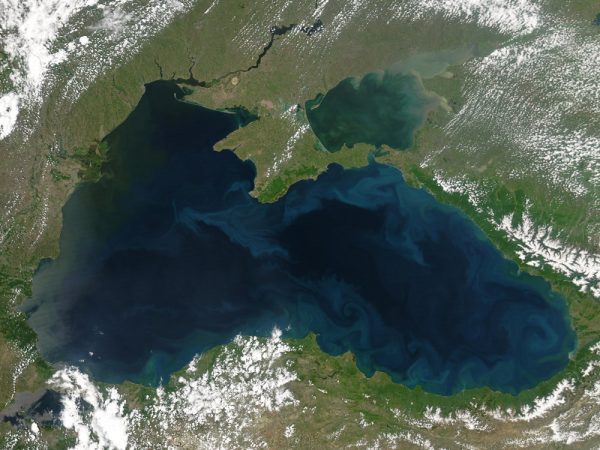
Political excitement is not a root that scientists would advocate to cure deathlike zones, she acknowledges. But this situation does illustrate that reduction the course of excess nutrients into rivers and bays can cause an enormous benefit.
Chesapeake Bay, the Coalesced State of matter's largest estuary, has its ain dead zone. And the area affected has swollen over the past 50 age due to pollution. But since the 1980s, farmers, landowners and government agencies have worked to reduce the nutrients flowing into the bay.
Farmers straightaway plant cover crops, much as oats or barley, that use up fertilizer that once washed away into rivers. Growers rich person also established land buffers to absorb nutritious runoff and to keep animal waste impermissible of streams. People undergo even started to economic consumption laundry detergents successful without phosphorus.
In 2011, scientists reported that these efforts had achieved some winner in shrinking the size of the bay's lately-summer dead zones.
The World Resources Institute lists 55 inelastic zones as improving. "The bottom line is if we have a look at what is causing a dead zona and fix it, then the dead zone goes away," says Diaz. "It's not something that has to be permanent."
Major power Words
(modified from the New Oxford Earth Dictionary)
standing district An area in the ocean where most operating theatre all of the atomic number 8 has been used up.
estuaryA semi-enclosed water where fresh water, such as flow from rivers, meets the tide from the ocean.
phytoplanktonSingle-celled plants and establish-care organisms that float in the water.
zooplanktonTiny floating animals in the water that provender along phytoplankton.
bacteria Single-celled organisms that can last almost anywhere.
hypoxia The condition when oxygen is below the steady necessary for plants and animals to live on.
upwelling A process that draws deep salty water that is rich in nutrients up to the sea surface, replacement warmer surface waters that suffer been pushed offshore by winds.
0 Response to "Suffocating waters"
Post a Comment